Auden’s bicycle
Along for the RideAuden’s bicycle turns an ordinary skill into a measure of how she responds to failure: after learning through repeated falls and Maggie’s patient instruction, she rides on her own and chooses a difficult leap rather than retreat. Its importance lies not in speed or mastery but in the small, physical decisions that let Auden keep trying.
A Difficult Beginning
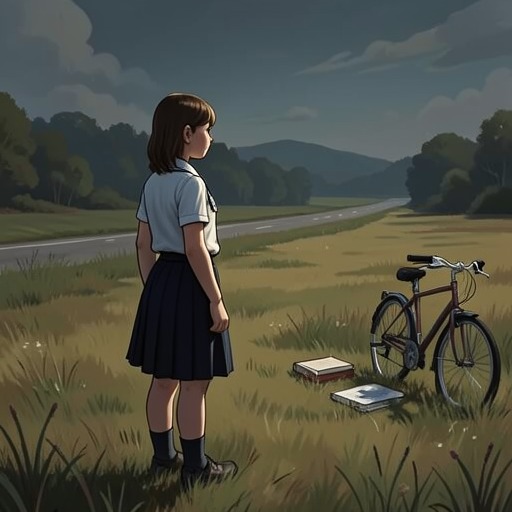
At the jump park clearing, early one morning, Auden discovers that she does not know how to ride. The ability does not return as a forgotten confidence; each attempt to move forward brings panic, a wobble, and a fall. Once, she travels about forty yards only because Maggie holds the back of the seat. When Maggie releases it, Auden veers into bushes and falls again. The distance is real, but it has not yet become independent movement.
The lesson is humiliating to Auden precisely because it seems so basic. After more than an hour of trying, she wants to quit. She repeatedly has to get up and brush sand and gravel from her knees while Maggie answers each fall with encouragement. The bicycle makes the gap between knowing that children learn this skill and being able to perform it immediate: Auden cannot think her way past the wobbling, and progress requires another attempt.
Practice and Incremental Progress
The following week, learning becomes a morning routine. Auden picks up two coffees at Beach Beans and meets Maggie at the clearing. Following Adam’s advice, they begin with assisted riding: Auden pedals while Maggie holds the seat. They then increase, bit by bit, the time Maggie lets go, at first running behind so Auden will not topple over. The method gives Auden support without mistaking support for the finished achievement; each interval asks her to balance and pedal for herself.
Progress remains imperfect. Auden has several more falls and still has scabs on both knees, but she is doing better than she did on the first morning. In one passage, she passes the bike shop while Eli is inside. She decides to let go for real and raises her hands as they go by. That brief gesture makes letting go more than a stage of practice: Auden acts on the confidence she has been building, even without knowing whether Eli sees her.
Riding also accompanies a change in the shape of Auden’s days. She now stays home at night to study and sleep, and is out in the morning and afternoon, including when she practices with Maggie. She remains mostly alone outside work and practice, and avoids messages from Jason and calls from her parents. She thinks of this withdrawal as part of an unfinished quest, while fearing that speaking to her parents might release feelings she has barely begun to face. The bicycle does not resolve those concerns, but the routine gives her a concrete activity and a recurring connection with Maggie amid them.
Choosing to Ride
Auden later tells Maggie that she has bought a bike. When Eli urges her to get back on it, Auden objects that it is not simple; his reply frames the next attempt as one more try. The exchange places the bicycle between encouragement and decision. Advice alone cannot ride for Auden, and the object becomes consequential only when she chooses to mount it again.
Before leaving one night, Auden has her keys in hand and intends to drive. Instead, she sees the bike beside the steps, climbs on, recalls what Maggie has taught her over the preceding weeks, and pushes off before she can change her mind. She is wearing a black dress and had considered taking Thisbe in a stroller, but the baby begins to cry. Auden’s choice of the bicycle is therefore made amid a disrupted plan, not in a calm lesson devoted solely to cycling.
As she rides, Auden approaches a curb beside a stoplight where Eli’s battered Toyota truck is stopped. She recognizes that she must either brake and turn or try to jump the curb. Because Eli is there, she chooses the jump, intending to show him what she had tried to communicate earlier at the shop. The bicycle carries her into a risk she has previously met by giving in to a crash; this time, she keeps her eyes open, holds the handlebars, and manages to stay upright after landing hard. When she circles back, Eli has pulled over and is watching her. His astonishment confirms that the attempt has become visible to someone else, but the achievement belongs to Auden’s decision to keep control through the landing.
Independent Movement
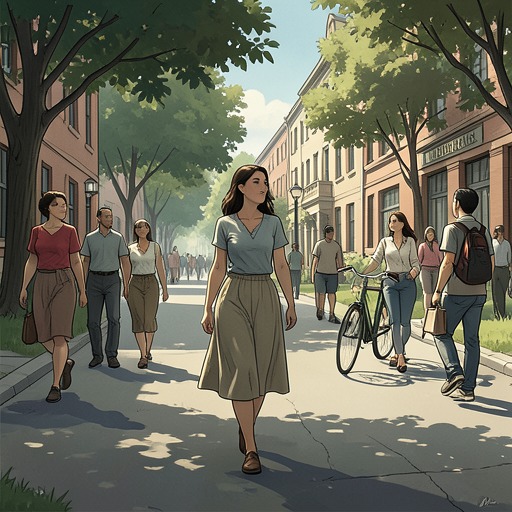
By October, at Defriese University, Auden rides across the empty campus to her dorm with a travel-lidded cup of cafeteria coffee balanced in one hand. The weather has turned colder, and a light drizzle begins as she reaches the bicycle rack. This later ride is quieter than the leap over the curb: no audience, challenge, or lesson is described. Its ordinariness shows how far the bicycle has moved from the morning when even starting brought panic. Auden can now use it to get herself across campus, making the learned skill part of daily life rather than a single dramatic test.